Authentic High-Hydration Ciabatta Bread: Achieving the Perfect Open Crumb
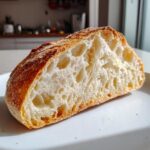
Make classic Italian ciabatta bread at home using this detailed recipe. You will learn the technique for managing the wet dough to achieve the signature large, airy holes.
- Prep Time: 20 min
- Cook Time: 40 min
- Total Time: 14 hours 0 minutes
- Yield: 2 large loaves 1x
- Category: Bread
- Method: Baking
- Cuisine: Italian
- Diet: Vegetarian
Ingredients
Scale
- 1 cup bread flour (high protein)
- 1 cup water (room temperature)
- 1/4 teaspoon instant dry yeast
- 1/2 teaspoon fine sea salt
- Extra flour for dusting
Instructions
- Prepare the Poolish: In a medium bowl, combine 1 cup of bread flour, 1 cup of room temperature water, and 1/4 teaspoon of instant dry yeast. Mix until just combined. Cover the bowl tightly with plastic wrap and let it sit at room temperature (about 70°F) for 12 to 16 hours until very bubbly and active. This is your poolish.
- Mix the Final Dough: In a large mixing bowl, pour in all of the active poolish. Add the remaining 1/4 teaspoon of instant dry yeast and 1/2 teaspoon of fine sea salt. Gradually add 1/2 cup of water, mixing slowly with a wooden spoon or spatula until the dough comes together. The dough will be very wet and sticky; this is correct for high hydration bread baking.
- First Rise (Bulk Fermentation): Cover the bowl and let the dough rest for 30 minutes. Perform a set of stretch and folds: gently stretch one side of the dough up and fold it over the center. Rotate the bowl 90 degrees and repeat three more times (four folds total). Cover and rest for 30 minutes. Repeat this stretch and fold process two more times, resting 30 minutes between each set. After the final set, let the dough rest undisturbed for 1 to 1.5 hours, or until it has increased in volume by about 50% and looks airy.
- Shape the Loaves: Generously dust a work surface with flour. Gently scrape the dough out of the bowl onto the floured surface. Do not punch it down. Lightly dust the top of the dough. Using a bench scraper, gently divide the dough into two or three equal pieces. Do not handle the dough aggressively; you want to preserve the air bubbles.
- Final Proof: Gently stretch each piece into a rough rectangle shape. Place the dough pieces onto parchment paper dusted heavily with flour or semolina. Cover loosely with plastic wrap or a clean kitchen towel. Let them proof at room temperature for 45 to 60 minutes. The dough should look puffy.
- Preheat and Bake: About 30 minutes before baking, place a baking stone or Dutch oven inside your oven and preheat to 475°F (245°C). If using a Dutch oven, place the dough and its parchment paper inside. If using a baking stone, carefully slide the dough onto the hot stone using the parchment paper as a sling.
- Bake: Bake covered (lid on Dutch oven or with steam added to the oven) for 20 minutes. Remove the lid or steam source. Reduce the temperature to 450°F (230°C) and bake for another 15 to 20 minutes, until the crust is deep golden brown.
- Cool: Transfer the finished ciabatta loaves to a wire rack and allow them to cool completely before slicing to set the crumb structure.
Notes
- Use high-protein bread flour for the best structure in this high hydration bread baking recipe.
- If you prefer a sourdough ciabatta alternative, substitute the poolish with an equal weight of active sourdough starter.
- For a rustic Italian bread tutorial feel, use a baking stone and introduce steam by pouring hot water into a pan placed on the bottom rack during the first 20 minutes of baking.
Nutrition
- Serving Size: 1 slice
- Calories: 180
- Sugar: 0.5
- Sodium: 250
- Fat: 0.5
- Saturated Fat: 0.1
- Unsaturated Fat: 0.4
- Trans Fat: 0
- Carbohydrates: 37
- Fiber: 1.5
- Protein: 6
- Cholesterol: 0
Find it online: https://cravybite.link/ciabatta-recipe-airy-italian-bread/